Claim
A Suitable Site Can be Found For The System
Evidence
When evaluating launch infrastructure, discussions often begin with the siting requirements of conventional rockets. These systems typically require coastal launch sites where no populated land lies downrange, reducing the risk that debris from a malfunctioning vehicle could impact people or property. Facilities such as Cape Canaveral illustrate the scale of land that must be dedicated to this purpose. A large buffer region must be reserved exclusively for launch operations, while surrounding areas may experience reduced property values due to the noise, vibration, and safety considerations associated with frequent launches.
These constraints can intensify as launch systems grow larger and launch cadence increases. Heavy-lift vehicles generate extremely high acoustic energy at liftoff. If boosters return to the launch site, sonic booms occur over populated regions. If upper stages are also designed for recovery, their reentry trajectories expose areas below the return flight path to sonic boom and debris risk, which can discourage residential development and reduce property values in affected areas.
For any large-scale space infrastructure project, whether supporting lunar development, Mars settlement, or the deployment of extensive orbital infrastructure, identifying suitable launch sites is therefore a nontrivial challenge regardless of the launch technology employed.
Launch site suitability depends on several factors, including the required size of safety keep-out zones, land acquisition costs, the size of the population potentially affected by noise or risk exposure, geographic latitude, accessibility to industrial and transportation infrastructure, prevailing weather patterns, and local geography.
The table below compares these considerations for a fully and rapidly reusable two-stage methylox heavy-lift launch system to low Earth orbit and for the Variable Pitch Screw Launch (VPSL) system.
| Siting Consideration | Methylox Powered Fully Reusable Rocket | Screw Launch Infrastructure |
|---|---|---|
| Downrange hazard zone | Large unpopulated downrange region required to accommodate potential ascent failures. Coastal sites are typically preferred to avoid overflight of populated land. | The vehicle remains mechanically constrained within an enclosed guideway during acceleration. Debris risk is therefore largely confined to the launcher's physical structure, substantially reducing downrange hazard requirements. |
| Acoustic impact | Extremely high acoustic energy during launch; repeated operations produce substantial noise exposure for surrounding communities. | Acceleration occurs inside an evacuated tube. The system is silent until the spacecraft exits the elevated evacuated tube and ignites its small rocket engine at approximately 12 km altitude and roughly 100 km offshore. |
| Sonic boom exposure | Large reusable boosters returning to the launch site generate sonic booms. Large returning upper stages also generate sonic booms and introduce debris risk below their return flight paths. | Small vehicles exit the launcher already traveling at hypersonic speed at high altitude and far offshore, reducing sonic boom exposure near the launch site. Launch infrastructure eliminates the need for returning boosters and upper stages. |
| Land use footprint | Large exclusion zones are typically required around launch pads and along ascent and return flight paths. Surrounding areas can become less attractive for residential development due to noise and perceived risk. | The launcher itself may be physically long, but surrounding safety zones can be smaller because the system contains the acceleration process within engineered structures. Acceleration and ramp sections can be located inside conventional or submerged tunnels, further reducing surface impact. |
| Latitude sensitivity | Rocket economics follow the rocket equation and scale approximately with exp(v). Small increases in required delta-v significantly increase propellant mass, favoring launch sites closer to the equator. | VPSL system energy scales approximately with v². This makes the economics less sensitive to modest increases in required orbital velocity, so latitude remains beneficial but is less decisive. |
| Accessibility | Rocket launch operations require methane fuel and large quantities of liquid oxygen, typically produced using electricity. Sites may therefore require ports, pipelines, tanker truck access, or nearby industrial infrastructure. Heavy-lift rockets are extremely large and difficult to transport, often requiring local manufacturing facilities and a workforce community. | VPSL infrastructure primarily requires electrical power. Power transmission lines can be extended to remote locations more easily than the continuous delivery of liquified propellants. VPSL launch vehicles can be manufactured in existing industrial centers and are small enough to be transported to the site by train or truck. |
| Weather sensitivity | Launch operations are sensitive to winds, lightning, and precipitation. | Most acceleration occurs inside a controlled, evacuated environment, reducing sensitivity to many atmospheric conditions. However, the elevated evacuated tube (EET) structure cannot withstand all possible weather conditions. During severe weather events, launch operations must be suspended so the EET can be retracted and coiled into a protected stowed configuration until conditions return to acceptable limits. |
| Geography | Launch pads can be constructed on relatively flat terrain, although coastal geography is usually required to provide a safe downrange corridor over open water. | The VPSL architecture requires suitable terrain to support the ramp section that redirects the spacecraft skyward, typically involving a tall mountain. |
In summary, both conventional rockets and the VPSL system impose meaningful siting constraints, but the nature of those constraints differs. Rocket launch sites are primarily shaped by the risks associated with large chemical propulsion systems, which drive the need for extensive downrange safety corridors, large acoustic buffer zones, and coastal locations. The VPSL system, by contrast, performs most of the acceleration within an engineered guideway, reducing the need for large downrange hazard areas and substantially lowering launch-site noise impacts.
At the same time, the VPSL architecture introduces its own geographic requirement: the ramp section that redirects the spacecraft skyward must be supported by suitable elevated terrain, typically a tall mountain or similar landform. This requirement narrows the set of candidate locations relative to flat-terrain launch pads.
In practice, however, launch site suitability is determined by the aggregate of many factors, including safety zones, population exposure, geography, logistics, weather, and cost. A site that is less favorable in one dimension can still be viable if advantages in other categories compensate. When evaluated across the full set of constraints, it is reasonable to conclude that suitable locations for a VPSL installation can be identified.
One such site, put forth as an illustrative example, is in the Hawaiian Islands.
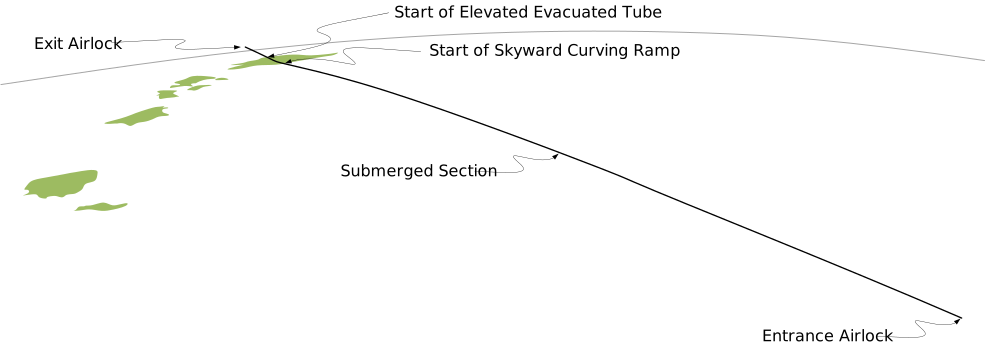
Hawaii's Big Island offers a compelling combination of low latitude, high-altitude geography, an easterly downrange trajectory over the ocean, and its status as US territory. Some concerns around the potential use of this site were discussed in an article posted on Space Settlement Progress.
Other countries, such as China and India, could take advantage of the high altitudes of the Tibetan Plateau (~5000 m) to site ground-launch infrastructure. Mount Teide (3,715 m) on Tenerife in the Canary Islands is a possible site closer to both Europe and Africa. The French island of Réunion in the Indian Ocean also has promising terrain for supporting an upward-curving ramp. Fogo, Cape Verde, dominated by Pico do Fogo (2,829 m) - an independent African nation with close economic ties to the European Union - is another possible site. The island of Tristan da Cunha, a remote British Territory in the South Atlantic, has a 2,062-meter-high peak.
Reviews
The following reviews are limited in scope to the validity of the claim made above, and do not imply that the reviewer has taken a position regarding any other claim or the overall feasibility of a concept that is supported by this claim.
- 1Verdict: SupportsSpace Programs Infrastructure and manufacturing planner with decades of experience. Projects include NASA Commercial Crew vehicles, Blue Origin launch infrastructure and space vehicles manufacturing, ISS logistics and support, Space Force infrastructure.
“Launch site can also be found on the ground.”
A continuous, low-relief corridor from western Arizona into central New Mexico makes it physically plausible to site an 800 km evacuated tube aligned roughly west–east, then terminate in foothills at about 2.7 km elevation. The Arizona/New Mexico Mountains Ecoregion is framed by broad desert basins and high plateaus, so you can trace a route that starts close to the lower Colorado River plain in western Arizona and climbs gradually toward high terrain near the central New Mexico ranges and associated mesas. This combination of long, relatively unobstructed desert and accessible high ground is rare and directly supports the kind of horizontal-to-uphill geometry a Variable Pitch Screw Launch system needs.
From a length and topography standpoint, the required 800 km is well within the scale of existing regional geography between western Arizona and central New Mexico. The straight-line distance from the Arizona–California border near the lower Colorado River to the vicinity of the central New Mexico mountain front and mesas (for example, around the Cibola National Forest region and approaches to the Manzano/Magdalen–Socorro–VLA area) is on the order of several hundred kilometers, with room to trace a non-straight but gently curving alignment while still achieving an effective tube length of ~800 km. Elevations in central New Mexico climb from roughly 1.5–1.7 km basins up to well over 3 km in the adjacent ranges, so finding a 2.7 km outlet location on a suitable slope or mesa is geophysically feasible without extraordinary earthworks, while keeping the bulk of the line in lower, flatter desert basins for cost and constructability.
Land-use and airspace context in New Mexico already favors aerospace infrastructure, which strengthens the case that similar terrain can host a large, linear system like VPSL. Spaceport America, south of central New Mexico’s main mountain front, illustrates how sparsely populated desert with minimal vertical development, extensive restricted airspace, and favorable weather (roughly 340 clear days per year) can be secured for space launch operations and long runways, even if that facility itself is far shorter than 800 km. That same mix of low-density desert corridors and nearby high terrain that enables existing horizontal and vertical launch activity in New Mexico implies that, with corridor acquisition and right-of-way control across Arizona and New Mexico, a west–east 800 km tube with a terminal elevation of about 2.7 km is not just topographically possible but operationally compatible with the broader regional aerospace environment.
Submitted:
