Work in progress: The author has indicated this claim is still being worked on and not yet ready for review.
Claim
Adaptive Nut Magnetic Drag is Within Acceptable Limits
Evidence
The adaptive nut is the moving element that couples to the variable-pitch screw flights to generate axial thrust. Any coupling method that produces thrust also produces some opposing force (drag / slip loss). The claim is that this drag is small enough (i) not to cap achievable screw flight pitch (lead ratio), and (ii) not to impose unacceptable waste heat or power loss.
The VPSL's drive system resembles a magnetic worm-gear. The screw flight defines a helical spatial constraint and the adaptive nut supplies a magnetic normal force to that constraint. Axial motion arises from this geometry as opposed to the mechanism of coupling to a propagating magnetic field - a mechanism used in many other classes of electromagnetic launchers.
We consider two coupling classes:
- Repulsive (inductive / electrodynamic) coupling, analogous to Inductrack
- Attractive (magnet-to-ferromagnet) coupling, with drag dominated by eddy currents / hysteresis unless mitigated
Analysis Common to Both Cases
Let's use the coordinate system of the digital twin for labeling variable. In this coordinate system, forward acceleration occurs along the positive y-axis. Upward is defined and being the direction away from the planet's surface and is along the positive z-axis. Rightward is defined as being along the positive x-axis.
In both cases the speed of the adaptive nut as a function of time is
The screw segments all rotated at a constant angular velocity in radians/sec. The average speed of the contact patch of a screw flight is
For context, in the VPSL reference design for launching spacecraft to Mars, at the end of the horizontal acceleration section, , the mid-contact-patch radius is , and the speed at the middle of the contact patch of the screw flight is .
The relative speed at the interface between the grapplers and the screw flights, , is
The pitch of the screw flight (launcherScrewThreadPitchAtExit ) at the end of the horizontal acceleration section is
The angle of the screw flight relative to the adaptive nut's direction of travel is
To incorporate the lift/drag ratio at the coupling interface into our calculations, its helpful to consider how the worm-drive system is analogous to an ice-boat travelling upwind on a close-hauled tack. The adaptive nut is analogous to the iceboat which is confined to travelling along a fixed path by the guide way in one case and by the ice and skates in the other. The screw flights are the driving medium analogous to the wind. The adaptive nut's grapplers are analogous to the iceboat's sail. In the case of an iceboat, the apparent wind direction is the direction that the wind seems to be travelling from the perspective of someone on the iceboat. This is analogous to the direction the screw flights on one side of the adaptive nut seem to be moving from the perspective of someone on the adaptive nut. Mathematically, this vector is
Where is the unit vector in the rightward direction and is the unit vector in the forward direction..
The analogy is imperfect in that the VPSL system employs two counter-rotating screws, which would correspond to two simultaneous “winds” moving in different directions. To preserve clarity, let's consider the interaction with a single screw.
Now in the adaptive nut's frame of reference, the screw flights on one side are moving along the vector, and the screw flights on its other side are moving along a mirror image vector. If repulsive coupling is used, then the two vectors make a V shape, with the V pointing aft. If attractive coupling is used, then the two vectors still make a V shape, but in this case the V points forward.
If the screws were constant pitch, then from the adaptive nut's perspective, this arrangement would be static and it would advance forward at a steady speed. But because the screws' pitch is variable,
Repulsive Coupling - Inductrack method
To derive the math that calculates the adaptive nut's magnetic drag from other known parameters, let's start with a simplified scenario. Image that there are two angled plates (stand-ins for the flights on the counterrotating twin screws) that are squeezing the adaptive nut in the manner of a watermelon seed being squeezed between two fingers. Imagine that the vehicle's forward velocity is constant, but that there is an opposing force, such as aerodynamic drag, that is resisting the forward motion of the vehicle.
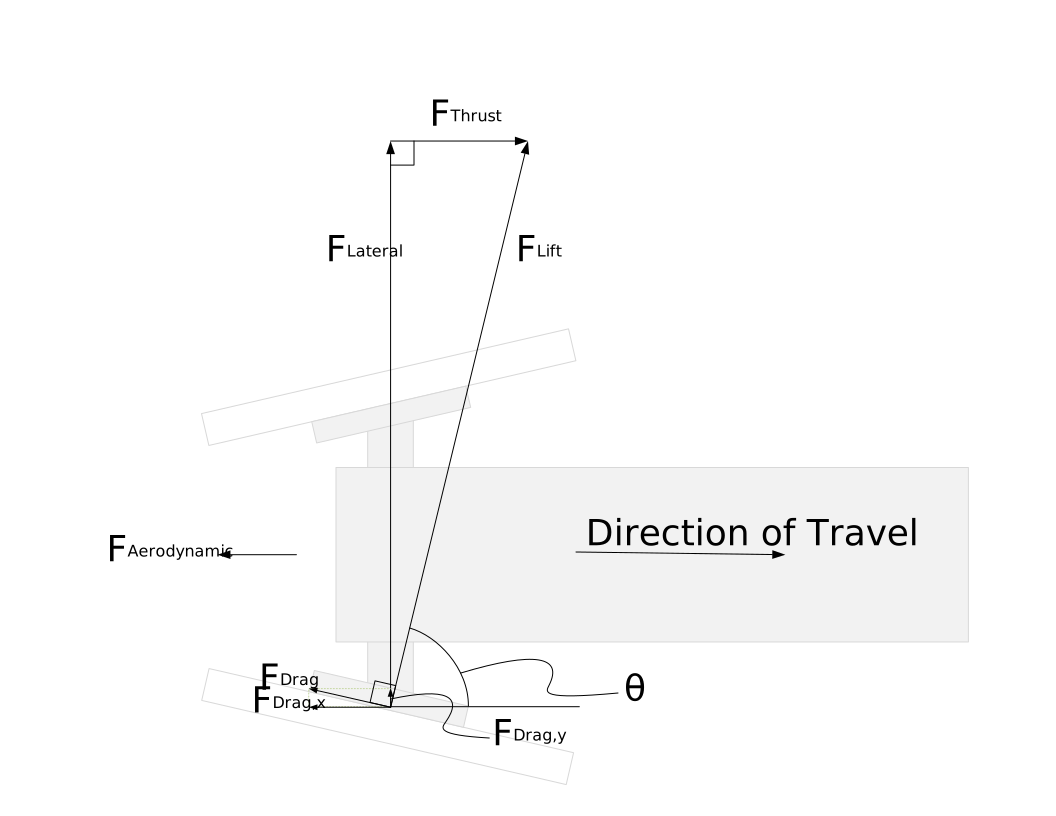
To maintain speed, the angled plates must apply lateral "squeezing" forces, . Each lateral force is converted into a forward force, , by the geometry of the screw, so that
At the coupling interface, there is a repulsive force perpendicular to the plate which is
There is also a magnetic drag force which is parallel to the plate which is related to the lift force by the magnetic levitation system's lift-over-drag ratio,
Finally, the magnetic drag force can be broken down into its x and y components. (Note that this diagram's coordinate system differs from that of the digital twin).
We then get
Note that and are negative.
To maintain a steady velocity, we need to satisfy
... where the factors of two are introduced because there are two plates squeezing the adaptive nut.
Now it's possible to calculate , which value that will be needed to calculate how much power will be lost to magnetic and aerodynamic friction.
First we substitute in and to get
Then we substitute in to get
Finally we can factor and rearrange to solve for
We could also solve for to determine how much force needs to be applied, but that formula is not relevant to this particular claim.
To compute the actual drag force, we need to evolve this analysis from a steady speed case to the accelerating case. This simply requires adding in an additional term for the inertial force, , that the thrust also needs to overcome to achieve the desired acceleration. This force can be calculated with
So the resulting formula is
Lastly, we need to calculate the power loss associated with . The speed at the coupling interface is () the speed of the adaptive nut divided by , so the power loss is
Now that we have derived the needed formula, we must determine the numbers that we need to plug into it.
Inductrack lift/drag is a function of relative speed at the interface
For an Inductrack-style RL track model, Post & Ryutov give (their Eq. 12): where
- = spatial wavelength of the magnetic field pattern seen by the loops (along the motion direction)
- = effective inductance of a representative track circuit (self + mutual, per their model)
- = effective resistance of that circuit
- = relative speed along the wavelength direction
Mapping to the grappler–flight interface, use :
Source: Post & Ryutov, “The Inductrack Approach to Magnetic Levitation,” Eq. (12).
- Relating “lift” to “thrust” in the worm-gear constraint
Let
- = magnetic “lift-like” normal force between nut and flight (normal to the local flight surface)
- = axial thrust delivered to the nut
Geometric resolution (ideal constraint, ignoring losses) gives:
Inductrack “drag” force (dissipative) is then:
so
Attractive Coupling
In the ideal limit (if the adaptive nut were infinitely long) the magnetic field would be static in the nut frame and static in the screw frame. In practice the adaptive nut's length is finite, so in the screw's frame (the frame observed from of any given position along the screws) the magnetic field varies as the adaptive nut passes by, first increasing, then staying steady, then decreasing.
Reviews
The following reviews are limited in scope to the validity of the claim made above, and do not imply that the reviewer has taken a position regarding any other claim or the overall feasibility of a concept that is supported by this claim.
No reviews yet.