Work in progress: The author has indicated this claim is still being worked on and not yet ready for review.
Claim
An Exit Altitude of Approximately 15 km (~49,000 ft) Enables Safe Endoatmospheric Transit
Evidence
When evaluating the feasibility of launching a high-velocity projectile directly into space, one of the main objections is that the lower atmosphere is simply too dense—producing extreme dynamic pressures and intolerable aerodynamic heating. At sea level, the air density is so high that a vehicle traveling at 11 km/s would encounter heating rates beyond the capacity of any practical thermal management system. Conversely, at very high altitudes (above about 50–60 km), the atmosphere is thin enough, and the duration of atmospheric transit is short enough, that aerodynamic heating becomes a minor or even negligible concern.
This claim is best framed as a first-order plausibility argument, as extensive aerothermal validation on a near-final vehicle design would be required to properly assess endoatmospheric transit safety. The purpose of this claim is to assert that at an altitude of approximately 15 km, the air density is sufficiently low to limit both dynamic pressure and convective heating to levels that can be managed through techniques such as short-duration active cooling, and the use of ablators. This altitude represents a practical compromise between two competing engineering challenges: designing the vehicle’s thermal management system to withstand higher heat fluxes at lower altitudes, or extending the elevated evacuated launch tube to much greater altitudes where such heating would no longer be significant. The 15 km regime is thus identified as a technically demanding but feasible operating point—one that can be achieved with available materials and proven engineering techniques, without requiring any breakthroughs in science or technology.
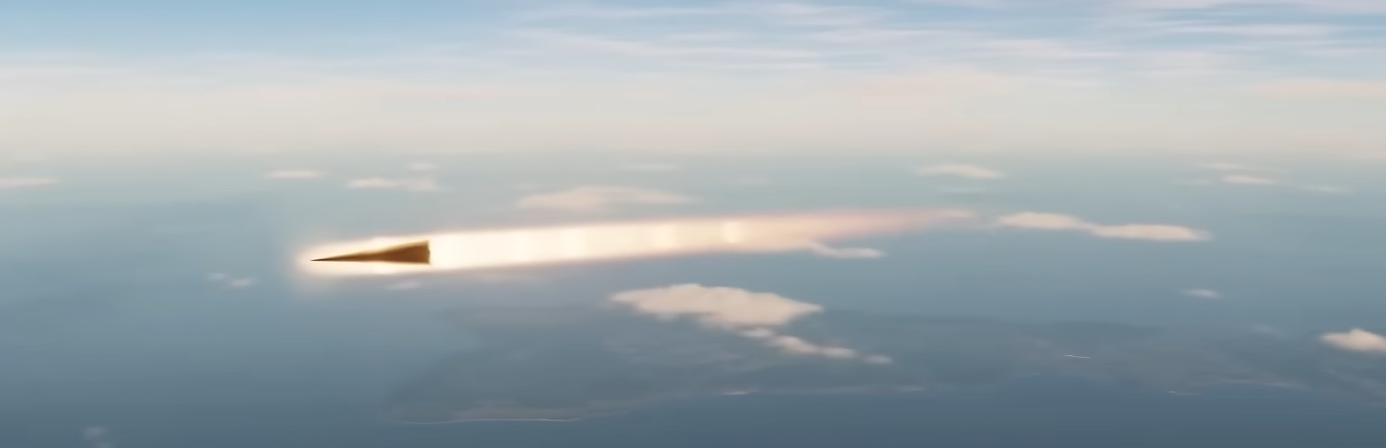
When a vehicle exits the elevated evacuated tube at an altitude of approximately 15 km (~49,000 ft), its speed in the inertial reference frame will be 11,546 m/s, but because the Earth is rotating in the same direction as the vehicle's travel, its airspeed will be 11,110 m/s (~Mach 37.7). The air pressure at 15 km is 0.119 atm, and the air density is 0.192 kg/m³. The initial flight enthalpy, , is 61.7 MJ/kg. Airspeed is maintained, but air density drops as the vehicle gains altitude. The following charts show results produced by the digital twin.
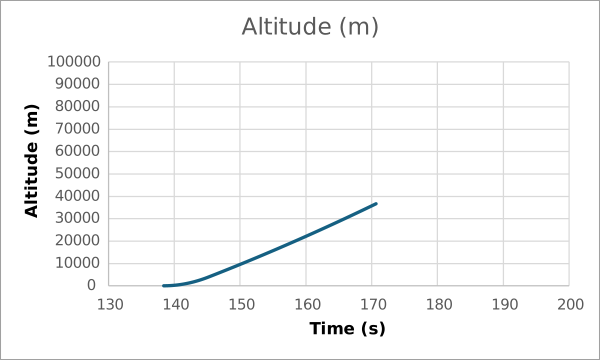
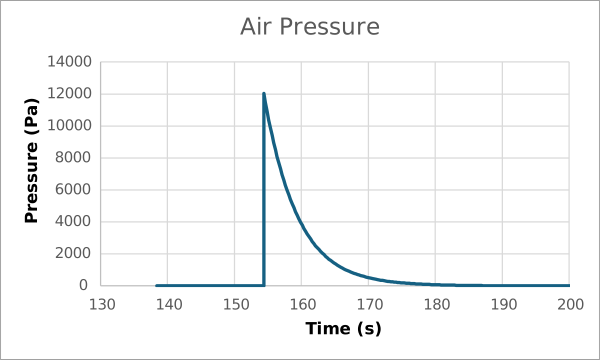
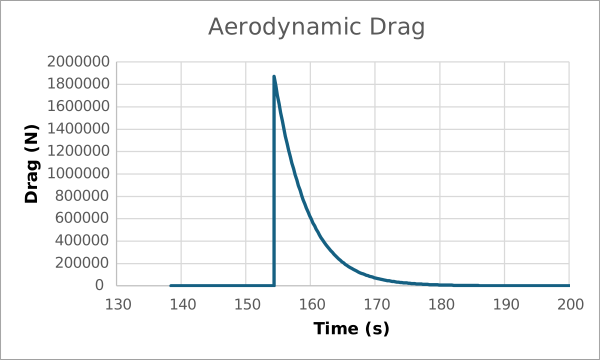
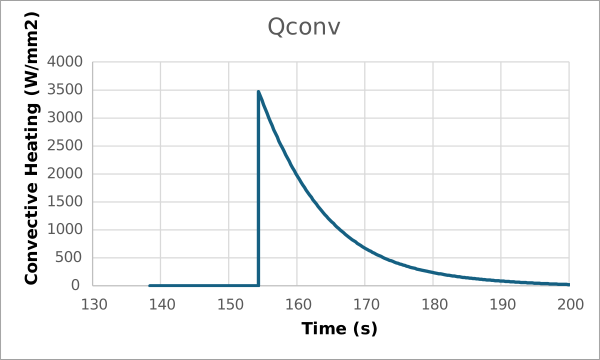
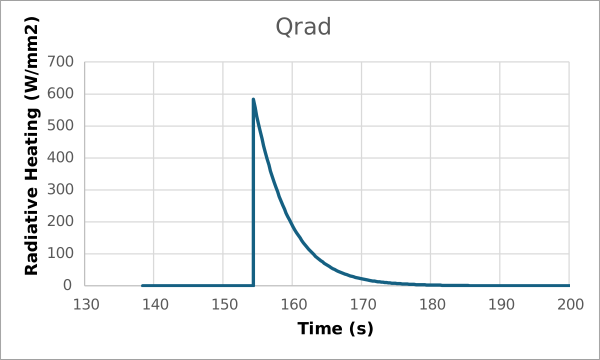
The vehicle design minimizes atmospheric drag with a long, slender nosecone that narrows to a hemispherical tip. The tip radius may be very small initially (e.g. 1 mm) to minimize the atmospheric drag coefficient, but will quickly ablate away as the spacecraft gains altitude. As the tip ablates, the tip radius will increase as will the coefficient of drag, but this will be partially compensated for by he decrease in air density that accompanies increasing altitude.
Studies by the Universities of Minnesota and New Orleans, two members of the Multidisciplinary University Research Initiative (MURI) supported by the U.S. Air Force Office of Scientific Research (AFOSR), investigated the aerothermal behavior of a 10-kg projectile for flight from a high-altitude (16 km) launch into orbit. They used existing and newly developed codes to model the aerothermodynamics of ablating TPS nosetips for slender high-beta flight bodies. The results showed that with a carbon-carbon projectile heat shield, an acceptable amount (15 mm) of nosetip ablation occurs. These studies are covered in more detail in the article "Progress on Hypervelocity Railgun Research for Launch to Space", by Ian McNab.
Let's assume that the nosecone tip is fabricated from TZM molybdenum alloy, a refractory metal that combines very high-temperature capability with high thermal conductivity and mechanical strength. It retains a yield strength over 250 MPa at 1000–1200 °C, conducts heat at approximately 125 W m⁻¹ K⁻¹, and melts near 2620 °C. These properties make it ideal for withstanding brief, intense aerodynamic loads and spreading heat effectively—ensuring both structural and thermal integrity without requiring exotic materials.
Stagnation Dynamic Pressure
The first concern is dynamic pressure — the direct mechanical load from the airflow. It’s given by
For a small hemispherical TZM tip, the resulting membrane stress is
well below the alloy’s yield strength of over 250 MPa at 1000 °C. In short, the structure easily withstands the aerodynamic load; the real challenge lies in managing the heat, not the pressure.
Convective Heating
The second concern is convective heating at the stagnation point — the intense thermal flux generated as air molecules are suddenly decelerated and compressed against the nose tip. It can be estimated using the relation
where for air. Substituting the known values,
Thus, the convective heating rate at the nose tip reaches about 3.47 kW per mm², an immense but brief heat flux that must be handled through active cooling during the few seconds of dense-air transit.
Radiative heating
The third concern is radiative heating from the hot, post-shock gas. A common misconception is that it scales like (from chaining with blackbody ). In real Earth-entry shock layers, nonequilibrium chemistry, line emission, and self-absorption flatten the dependence; in the 10–12 km/s band a practical fit is closer to and proportional to density:
Using ...
So, at 15 km and 11.11 km/s, radiation adds hundreds of W/mm² which is significant, but still below the convective peak; therefore both terms must be included in the nose-tip cooling budget.
Active Cooling with Pressurized Liquid Water
We remove the tip heat by circulating liquid water under high pressure (e.g., ~100 atm) through fine capillaries near the hot face, using sensible heating only (no boiling). The required mass flow is set by energy balance:
Tip heat load (1 mm radius hemisphere, area ):
- Convective:
- Radiative:
- Total:
With liquid water specific heat and a pressurized temperature rise (e.g., , no flashing),
Thus,
Heating drops from its peak to ~50% in the first 5 seconds, to ~10% after 10 seconds, and becomes negligible after around 25 seconds.
A TZM nose tip with an embedded network of micro-capillaries feeds cool water from a small reservoir, runs it within a few hundred microns of the hot surface, and returns it to the reservoir after absorbing heat. High pressure suppresses flashing, maintains liquid-phase properties (high ), and keeps the system compact. Only a few hundred grams of coolant are needed for the entire endoatmospheric transit.
Nose Cone Side-Wall Heating
Heating along the sides of the nosecone is far less significant than at the tip because the airflow there is nearly tangential and passes through an extremely weak oblique shock. With a half-angle of about 3.4°, the shock is only slightly stronger than the Mach wave, so post-shock temperature and density remain low. As a result, the local heat flux along the sidewall typically falls to less than 5–15% of the stagnation-point value, making the tip the overwhelmingly dominant source of aerodynamic heating.
Total Aerodynamic Drag Versus Rocket Thrust
The peak aerodynamic drag on the vehicle at 15km is 1,872,865 N, which is equivalent to 82% of one of the Space Shuttle's main engines (the RS-25). Rocket thrust is used briefly to offset aerodynamic drag and it is vectored as needed to adjust or maintain the spacecraft's flight trajectory.
Conclusion
- At 15 km, the dynamic pressure is mechanically tolerable for a refractory-metal nose; the governing risk is peak aerothermal load.
- Using a 1 mm tip with short-duration, pressurized, sensible-only water cooling at ~22 g/s (peak) and a micro-capillary network to move heat into a compact reservoir, the nose-tip heat can be removed throughout the brief high-q window.
- Because the heating decays by an order of magnitude within ~10 s and becomes negligible by ~25 s, the total coolant mass and system complexity remain modest, supporting the claim that a 15 km exit altitude enables safe endoatmospheric transit for this profile.
- The peak aerodynamic drag on the vehicle is low enough to be fully counteracted by a single liquid-fueled rocket engine.
See also: "Mass Driver Update", "The Era Of Earth-Based Mass Drivers" here.
Reviews
The following reviews are limited in scope to the validity of the claim made above, and do not imply that the reviewer has taken a position regarding any other claim or the overall feasibility of a concept that is supported by this claim.
No reviews yet.