Claim
Earlier electromagnetic launcher designs showed steep, often near-cubic power-electronics cost scaling with exit velocity
Evidence
Background
The following sources are worth reading for context...
- Keith Lofstrom's reasoning here in the section entitled "The switching technology cost is proportional to the mass times the exit velocity cubed ..."
- Section IV, "Mass Drivers Versus Rockets", on page 6 of "Human-Rated Launch Infrastructure for the Interplanetary Era: Breaking Rocket and Legacy EML Cost Barriers"
- The Wikipedia page on Startram
Claim
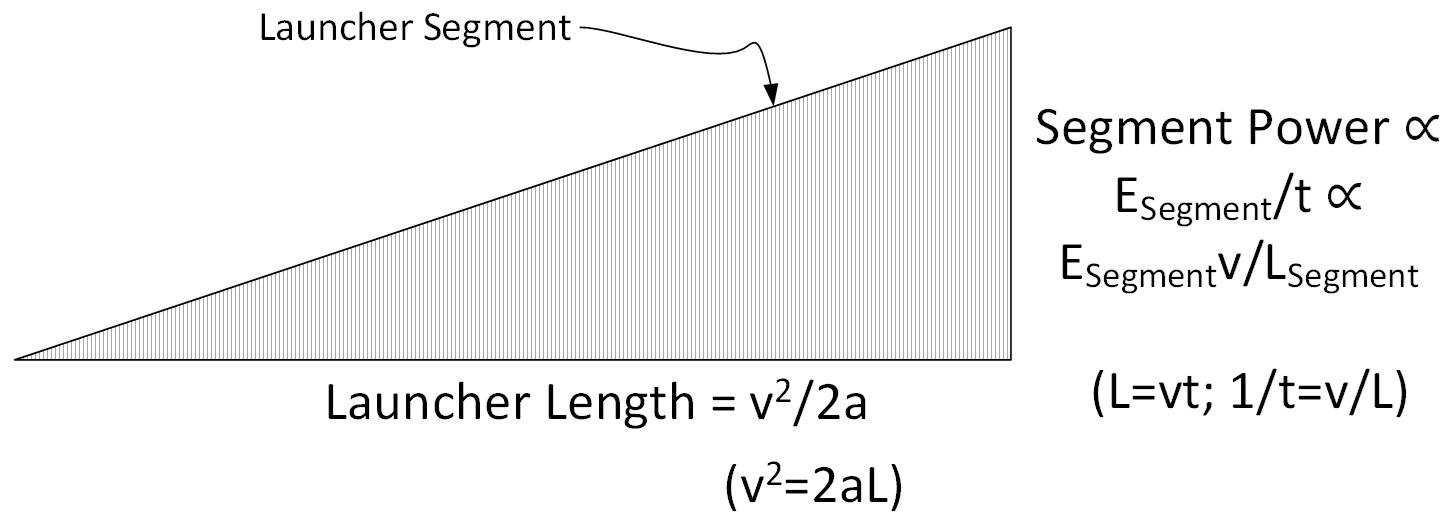
Earlier electromagnetic launcher designs exhibit steep, often near-cubic cost scaling with exit velocity because power electronics must convert electrical energy into kinetic energy in decreasing time as vehicle speed rises. While launcher length scales with velocity squared (), distributed acceleration requires each segment’s power capacity to scale linearly with velocity. Since the number of powered segments also scales with launcher length, total power-conversion and switching cost scales as . Real-world power electronics frequently scale even worse due to voltage, thermal, and reliability constraints, making cubic scaling an optimistic lower bound. This effect dominates system economics at orbital velocities and explains why traditional coilgun and railgun concepts have historically failed to produce affordable human-rated launch systems.
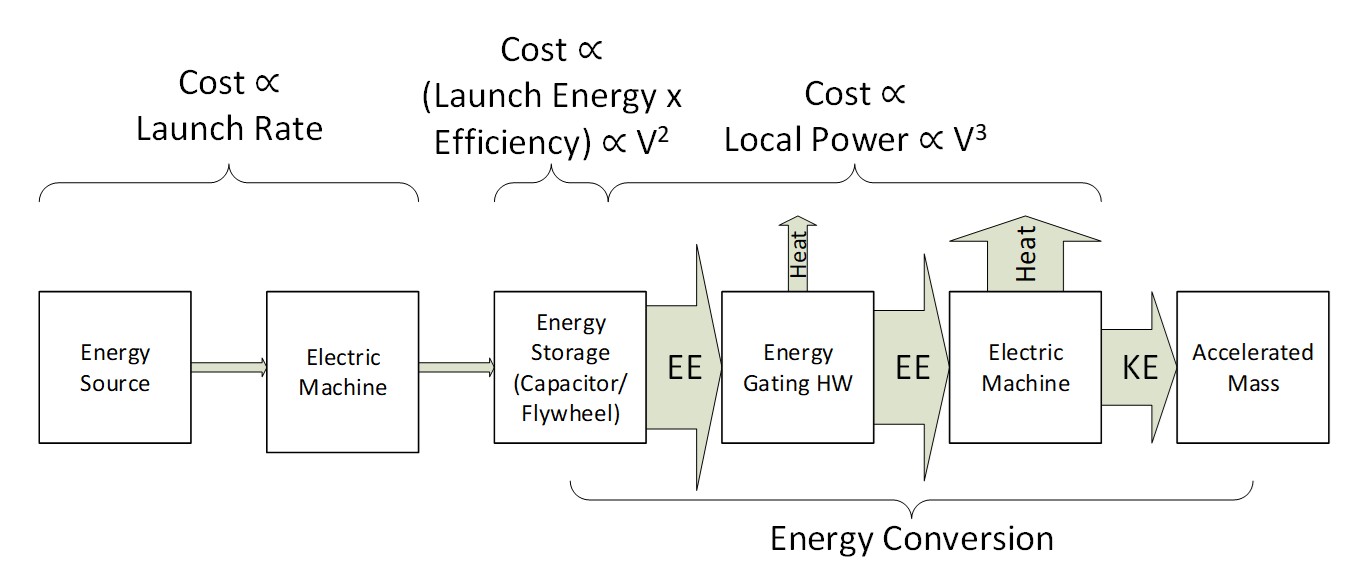
Referring to the figure above, The cost of the energy source and this first electric machine is proportional to the launch rate. The cost of most of the storage is proportional to the launch energy, which is proportional to velocity squared. The cost of the storage output, the energy-gating hardware, and the second electric machine is typically proportional to the power rating of the drive system's discrete segments, referred to as the "local power" in the figure. Because large launchers must be made from many discrete segments, and the number of segments is proportional to velocity squared, the total aggregate power handling capacity across all discrete segments roughly scales with velocity cubed, and thus the cost of this power handling capacity will also scale with velocity cubed.
Reviews
The following reviews are limited in scope to the validity of the claim made above, and do not imply that the reviewer has taken a position regarding any other claim or the overall feasibility of a concept that is supported by this claim.
No reviews yet.