Claim
The Elevated Evacuated Tube Can Survive Inclement Weather
Evidence
The Elevated Evacuated Tube (EET) is a type of aircraft, and like any other aircraft, it can operate in a wide variety of weather conditions. The Elevated Evacuated Tube (EET) is designed to remain airworthy and structurally safe across the site’s expected meteorological envelope. “Survive inclement weather” means (1) maintain station within defined limits during routine adverse conditions, (2) enter a controlled no-launch hold while continuing safe station-keeping in degraded conditions, and (3) execute a recover-to-hangar procedure before conditions exceed structural or control limits.
Engineering Specifics (Airworthiness & Control)
Airframe concept. The EET is an evacuated duct supported by distributed, electrically driven lift/propulsor units (with vectorable thrust) and lateral stabilization. Power is ground-supplied, reducing onboard energy storage and keeping thrust/weight margins high. The EET is engineered to be strong enough to hold a vacuum. It has an estimated length of 130 km when fully deployed, and its operational altitude ranges from the height of the mountain it is attached to up to an estimated 15 km at the high altitude end, where the exit airlock is located.
Station-keeping control law. A high-bandwidth, multi-axis controller (position + attitude + tube shape) rejects gusts via thrust vectoring and coordinated segment actuation. The control objective is decimeter-class lateral error in nominal winds and bounded error in higher gusts.
Environmental design envelope. Site-specific Design Operating Conditions (DOC) define limits on sustained wind, gust factor, turbulence intensity, precipitation, temperature, icing potential, and electrical activity (lightning). The EET’s operational envelope sits inside the DOC, and the recover-to-hangar threshold sits below any Maximum Expected Gust (MEG) / extreme event for the site.
Aero loads & fatigue. The evacuated interior eliminates internal aerodynamic loads; exterior loads are governed by dynamic pressure and segment form factor. Structural members and joints are sized for ultimate and fatigue under the site’s wind spectrum, with inspection intervals keyed to gust exceedance counts.
Operations by Regime
GO (Launch-permissive weather).
- Sustained wind and gust factor within Launch Weather Constraints (LWC).
- EET maintains on-path centering and attitude limits; visibility is irrelevant to centering because guidance is inertial/GNSS/optical-beacon-aided.
HOLD (No-launch, remain on-station).
- Conditions exceed LWC but remain within Station-Keeping Limits (SKL).
- Launch operations are paused. The EET maintains position with relaxed limits and larger safety buffers. Weather is monitored at high cadence using nowcasts (radar/satellite/wind), lightning risk within the local radius, and wind-shear/microburst indicators. Based on these signals, operations either return to GO or proceed to RECOVER before conditions exceed control or structural limits.
RECOVER (Return-to-hangar).
- Forecast or observed conditions trending toward or beyond Structural/Control Limits (SCL) (e.g., convective cells, strong wind shear, lightning proximity, or icing risk).
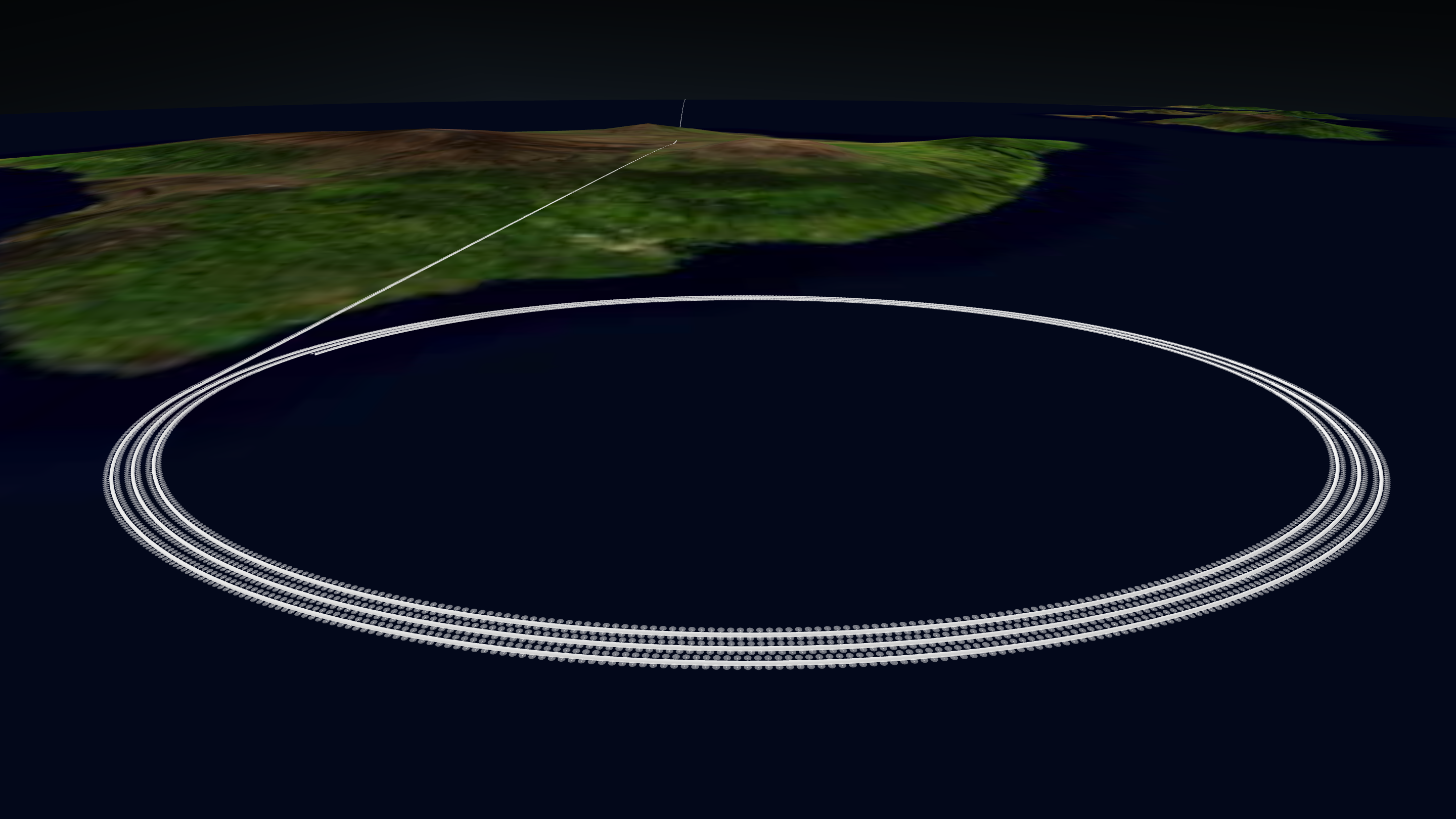
- Coil-and-stow procedure: As the EET flies back to the hangar, it coils itself in flight. When fully coiled, the EET aligns with the coil-shaped hangar, conducts a low-rate descent, and settles onto dedicated coil stands inside. The hangar’s roof and wall panels then close to secure and protect the coiled EET from the inclement weather.
Why visibility and ceiling are less critical here
Unlike crewed aircraft, the EET’s pilotage is automated and reference-agnostic (GNSS/INS + local beacons + onboard state observers). IMC (low cloud/visibility) affects launch safety rules for the spacecraft and range, but not the EET’s ability to hold or recover—so meteorological gating focuses on winds, shear, convection, icing, and lightning risk, not visibility minima.
Summary
The EET treats weather as an operational risk with explicit envelopes and procedures, not a binary pass/fail for airworthiness. With adequate thrust margin, gust-rejection bandwidth, segmented control, and a deliberate coil-and-stow recovery, the system remains safe through routine adverse weather, abstains from launch when conditions degrade, and proactively recovers to a survivable configuration before storm-class loads arrive.
Reviews
The following reviews are limited in scope to the validity of the claim made above, and do not imply that the reviewer has taken a position regarding any other claim or the overall feasibility of a concept that is supported by this claim.
No reviews yet.