Claim
The Energy Losses Due to Air Friction on the Spinning Screws are Acceptable
Evidence
If we assume that the vacuum level inside the evacuated tube, , is 5 Pa and the air temperature, , is 20°C (293.15 K), the air density inside the tube can be estimated using the ideal gas law:
where is the specific gas constant for dry air, 287.05 J/(kg·K).
The screw flights rotate with angular velocity . Based on a maximum flight-tip speed of 530 m/s and a flight-tip radius of 0.5 m, the angular velocity is:
We initially modeled the screw flights as flat plates travelling through stationary air, but later learned that this approach overestimates the drag because the rotating screws entrain the small quantity of residual gas surrounding them. We then switched to a different analytical approach based on Taylor–Couette flow. In fluid dynamics, Taylor–Couette flow consists of a viscous fluid confined in the gap between two rotating cylinders. A standard reference is Landau and Lifshitz, Fluid Mechanics, 2nd ed., Section 18, "Flow between rotating cylinders."
For an inner cylinder of radius , rotating at angular velocity , inside a stationary cylindrical boundary of radius , the torque per unit length is
where is the dynamic viscosity of the gas. The corresponding power loss per unit length is
For air at room temperature,
The actual launcher geometry does not consist of concentric cylinders. The evacuated tube has a radius of 4.5 m, while the two screw axes are separated by 6 m and are located 0.5 m above the tube centerline. The distance from either screw axis to the tube center is therefore
With a screw outer radius of 0.5 m, the minimum distance from the screw axis to the tube wall is approximately
Because the screw is offset within the much larger vacuum tube, there is no single outer-cylinder radius that exactly represents the actual geometry. We therefore estimate the loss using two concentric-cylinder cases. The first assumes that the screw is enclosed by a relatively small tube with m, corresponding to its closest distance to the tube wall. The second assumes a substantially larger surrounding tube with m, approximately the distance from the screw axis to the tube centerline. The actual viscous loss is expected to lie somewhere between these two idealized cases.
Using
the smaller-tube case gives
per screw.
For the larger-tube case,
per screw.
For two screws, the corresponding power losses are
and
The total length of the launcher sections containing spinning screws is 773 km + 75 km = 848 km. The total aerodynamic power loss is therefore estimated to be between
and
This corresponds to a total power loss of approximately
To put this in perspective, the vehicles in a single lane of an 848 km highway, assuming one vehicle passes every 5 seconds, and each vehicle consumes 0.20 kWh/km, would use about 122 MW.
Over a full 14 day launch season, the aerodynamic losses would consume about 38 to 41 GWh, compared with 28.3 GWh transferred to the 56 launched vehicles. So, even at 5 Pa, while the aerodynamic losses may be acceptable, they are still significant. Given that other facilities such as the LIGO gravitational wave observatory achieve much lower internal operating pressures, it may be worth specifying a lower vacuum level for the launch system in an effort to reduce the aerodynamic losses further.
Reviews
The following reviews are limited in scope to the validity of the claim made above, and do not imply that the reviewer has taken a position regarding any other claim or the overall feasibility of a concept that is supported by this claim.
- 1Verdict: SupportsBS Mechanical Engineering, Washington State University; Journeyman Bluestreak Mechanic (WA Card No. 173809); 10+ years Aerospace Fabrication, Boeing Commercial Airplanes; 2× NASA Innovative Advanced Concepts Fellow ('21 and '23); Chief Executive Officer, Unleashed Robotics, Inc.
“SU2 Simulations and Hand Calculations Support This Claim”
I ran this in SU2 as 2D compressible Reynolds Averaged Navier-Stokes (RANS) simulation in a rotating frame. A series of idealized smooth drum sims were completed first, to validate against preliminary calculations. Then, the actual eight-flight cross-section was run in a far-field domain and in a walled domain sized to the real tube, with laminar and Spalart-Allmaras (SA) turbulence runs compared. See https://www.github.com/Shootquinn/vpsl-screw-windage and Figure 1, below.
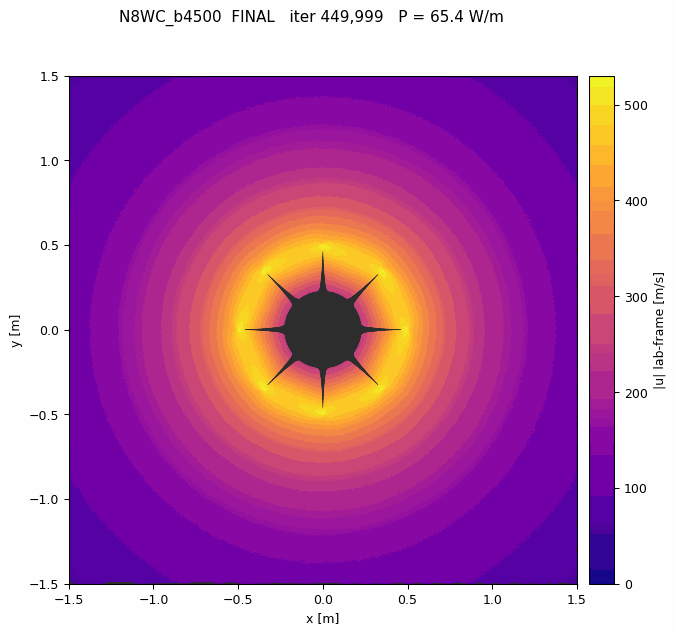 Figure 1: 8-flight screw in a 9 meter tube with 530 m/s tip speed using RANS-SA, computed to 500k iterations.
Findings
The smooth-drum runs validated within 6% of the 73.1 W/m that my own hand calculations predicted. The real, flighted screw came in lower than the idealized drum, not higher, since the flights expose less solid surface (wetted area) to the surrounding gas than a solid cylinder of the same tip radius (when co-rotation between flights is considered). The most complete screw case (walled domain, with SA turbulence), converged to 65.1-65.4 W/m per screw. Rotational Correction (SA-RC) had little effect and may not be necessary when using RANS-SA in this regime.
Areas for future investigation
- Off-center/Eccentric screw orientations. More advanced CFD simulations with an off-center screw location, resembling the design more closely, should be completed. However, these cases are far more complicated to set up and take longer to compute.
- Pressure optimization. Windage is pressure-independent in the continuum regime, so the operating pressure can be optimized as long as the result stays within the current regime. The regime should begin to change somewhere around 10 Pa, with very steep aero losses approaching 100 Pa.
- Benefit of a harder vacuum. The Knudsen-number slip correction only becomes material below about 0.5 Pa, an order of magnitude past the current design point. Aero optimization may not be possible if the next steep benefit comes at a 10x harder vacuum. Additional CFD simulations at lower pressures could help prove this out.
- Viscous heating in the shear layer. Viscosity can be evaluated at an elevated reference temperature to reflect viscous heating near the flight tips.
- Viscous heating over long-duration operation. Over weeks continuous duty, tube gas temperature may drift upward, raising viscosity and aero losses.
Submitted: · Edited:
