Claim
The Sonic Boom Impacts from Endoatmospheric Transit are Tolerable for Civilian and Environmental Exposure
Evidence
If the launch system is used to launch spacecraft to Mars, then launches will occur for a couple of hours around sunset, for about 14 days in a row during each launch season. Launch seasons occur once every 26 months.
If we assume that the ramp is supported by an island mountain, such as Monna Kea, then after being directed skyward by the ramp, the spacecraft will travel through the elevated evacuated tube and exit, roughly 100 km offshore, at an initial altitude of 15 km, which is approximately the altitude that the Concorde cruised at. During endoatmospheric transit, the spacecraft is expected to generate a sonic boom.
The spacecraft will have an airspeed of 11123 m/s. It has a very long, slender nose to minimize drag, much like NASA's X-59 "Quesst" aircraft, but it lacks wings or control surfaces and relies instead on directed rocket thrust to maintain its orientation.
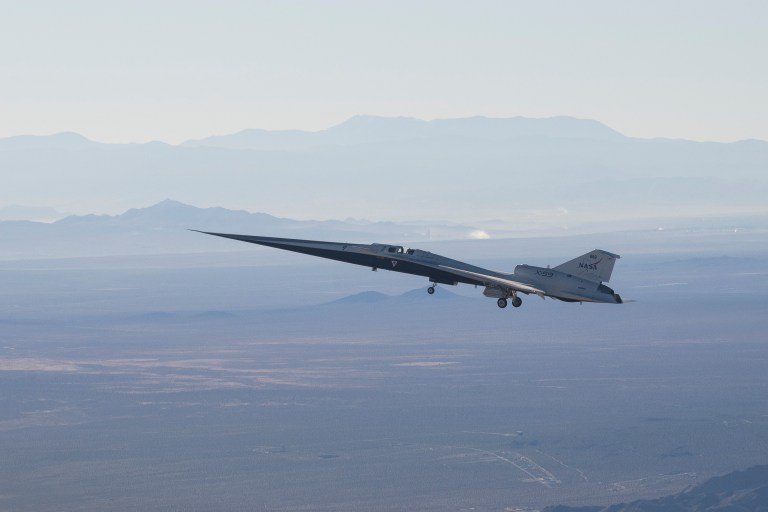
While in the atmosphere, the spacecraft may execute a pitch or yaw maneuver to adjust its trajectory aerodynamically; however, it should be noted that the spacecraft is traveling fast enough that its weight does not need to be transmitted to the ground through aerodynamic lift.
According to the Wikipedia article on Sonic booms, which it turn referenced these articles, "As the aircraft increases speed the shock cone gets tighter around the craft and becomes weaker to the point that at very high speeds and altitudes, no boom is heard."
As the spacecraft ascends, it rapidly reaches altitudes where far less of its kinetic energy couples into the surrounding air. The sound waves it does generate originate progressively higher in the atmosphere, and by the time they reach the surface, their intensity is substantially reduced by geometric spreading, which weakens amplitude approximately according to an inverse-square relationship with distance. Therefore, the region of the ocean directly below the EET's exit airlock will be the most strongly affected, with the acoustic impact diminishing downrange along the ground track.
While there are no civilians beneath the flight path where the sonic boom is expected to be strongest—aside from occasional sight-seers in small boats—the effect on marine life should be addressed explicitly. Prior environmental assessments for offshore rocket and hypersonic flight operations, including NOAA and FAA biological opinions, have examined how in-air sonic booms interact with the ocean surface. These studies consistently find that the air–water interface reflects most of the acoustic energy upward, so only a small fraction transmits into the water. As a result, underwater sound levels from overhead sonic booms remain well below established thresholds for marine-mammal injury and are generally classified as having minimal to negligible environmental impact.
To conclude, there are a number of compelling reasons to believe that the sonic-boom impacts from endoatmospheric transit are tolerable for civilian and environmental exposure. They include:
- The spacecraft exits the tube roughly 100 km offshore at an altitude of about 15 km, ensuring that the primary boom footprint or "carpet" remains well away from populated land.
- Its long, slender, low-boom nose geometry—similar in principle to NASA’s X-59—reduces peak overpressure by shaping and weakening the initial shock structure.
- At hypersonic speeds, the shock cone narrows and becomes weaker; at high altitude the boom may be imperceptible at long distances, as documented in prior aeroacoustic studies.
- As the vehicle climbs, progressively less of its kinetic energy couples into the air, further reducing the strength of any shock waves that can propagate downward.
- Sound originating at high altitude undergoes geometric spreading; by the time it reaches the ocean surface or distant land, the amplitude is greatly diminished.
- Launches occur only during short windows—about 14 days every 26 months—keeping overall exposure rare and well below frequencies associated with community annoyance.
- Over open ocean, the air–water interface reflects most acoustic energy upward, limiting impacts on marine life to levels considered acceptable in comparable federal environmental assessments.
Reviews
The following reviews are limited in scope to the validity of the claim made above, and do not imply that the reviewer has taken a position regarding any other claim or the overall feasibility of a concept that is supported by this claim.
No reviews yet.